

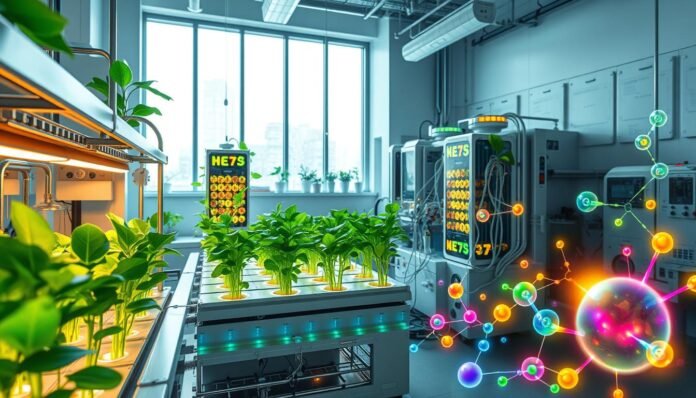

Standing in my backyard, I watch the sun’s rays play on the green leaves. It’s amazing to see how natural photosynthesis works. This process has kept life going for billions of years. Now, scientists are trying to copy this natural wonder to change how we get power.
They’re developing artificial photosynthesis. This technology aims to use the sun’s energy to make clean fuels. These fuels could solve our global energy problems. By studying how plants work, scientists are creating new systems. They hope these systems will be as good as nature’s.
Understanding Artificial Photosynthesis
Artificial photosynthesis is a way to capture solar energy and turn it into fuels, just like plants do. But, unlike plants, it aims to do this more efficiently. Researchers are working hard to beat the 3-6% efficiency of natural photosynthesis.
Photosynthesis Fundamentals
Plants and some microorganisms use sunlight, carbon dioxide, and water to make glucose and oxygen. This procedure is essential for life on Earth. It gives us food and the oxygen we need to breathe.
Contrasting Natural and Artificial Processes
Natural photosynthesis turns light into chemical energy in the form of glucose. Artificial photosynthesis wants to make fuels like ethanol or methane instead. It uses photocatalysts to turn sunlight into chemical energy, making hydrogen and other useful chemicals.
| Characteristic | Natural Photosynthesis | Artificial Photosynthesis |
|---|---|---|
| Energy Conversion Efficiency | 3-6% | Striving to Exceed Natural Limitations |
| Products | Glucose and Oxygen | Energy-Dense Fuels (e.g., Ethanol, Methane) |
| Approach | Natural Biological Processes | Biomimetic, Utilizing Photocatalysts |
Creating artificial photosynthesis technology for hydrogen has been slow. But, recent breakthroughs, like those by Professor Kazunari Domen in Japan, have shown big improvements. These advancements have made photocatalysts more efficient and hydrogen production better.
“The fundamental principle of photocatalysis, discovered approximately 50 years ago by Japanese researchers Akira Fujishima and Kenichi Honda, led to the development of high-performance photocatalysts, with Japan being a leading country in this field.”
As the technology gets better, artificial photosynthesis could change how we get energy. It could help solve the global energy crisis and lessen climate change’s effects.
The Scientific Explanation of Artificial Photosynthesis
Artificial photosynthesis is a field that tries to copy nature’s way of using sunlight. It converts sunlight into energy that can be used. At the core are photocatalysts, special materials that catch sunlight and start chemical reactions. These reactions divide water into hydrogen and oxygen.
Key Components and Mechanisms
The heart of artificial photosynthesis is water splitting. It divides water to create hydrogen and oxygen. Photocatalysts like graphitic carbon nitride (g-C3N4) mixed with potassium iodide are key. They have a 96.25% selectivity for oxygen reduction.
Adding I-/I3- redox mediators has been a big step forward. It helps separate and move charge carriers better. This boosts the system’s ability to make hydrogen efficiently.
Catalysts’ Importance in Converting Energy
- Photocatalysts are vital in artificial photosynthesis. They catch sunlight and start reactions for water splitting and hydrogen production.
- Researchers have made advanced catalysts like g-C3N4 mixed with potassium iodide. They show high selectivity and efficiency.
- The use of I-/I3- redox mediators has improved charge carrier separation and migration. This enhances the system’s dual-channel catalytic synthesis.
- These catalyst improvements have been key in advancing artificial photosynthesis. They bring it closer to being used on a large scale.
“The potential impact of this innovative technology on industrial and transportation sectors is significant, with hydrogen possibly replacing fossil fuels due to its clean energy properties.”
As research in artificial photosynthesis moves forward, scientists aim to make these systems better. They want to improve efficiency and stability. By working on material integration and new designs, they hope to make artificial photosynthesis a sustainable energy source for the future.
Why Artificial Photosynthesis Matters
Artificial photosynthesis is a key to fighting climate change. It mimics nature’s way of turning sunlight, water, and carbon dioxide into clean fuels. This tech could cut down greenhouse gas emissions and help our planet.
Addressing Climate Change
The University of Michigan has made a breakthrough in artificial photosynthesis. Their system can bind carbon atoms better than others, making ethylene. It works fast and efficiently, lasting 116 hours without losing power.
This device is a big step towards reducing carbon dioxide. It shows how artificial photosynthesis can help fight climate change.
Providing Sustainable Energy Solutions
Artificial photosynthesis is also a solution for our growing energy needs. It uses solar power to make hydrogen, a cleaner fuel than traditional ones. This tech could power big vehicles like trucks, ships, and planes.
The goal is to make liquid fuels from carbon chains. This would solve a big problem with solar power. If improved, artificial photosynthesis could remove 10 gigatons of CO2 from the air by 2050.
“Artificial photosynthesis has the potential to facilitate the production of chemical products without the need for hydrogen, using sunlight to decompose water and produce various compounds.”
Current Research and Innovations
Scientists are making big strides in artificial photosynthesis. They’ve created bioinspired hydrogels, which are like polymer networks that use sunlight to split water. This process makes hydrogen and oxygen.
A team from Japan Advanced Institute of Science and Technology (JAIST) and the University of Tokyo made these hydrogels. They designed the polymer networks to help split water efficiently. This is a key step in artificial photosynthesis.
The hydrogels have special molecules like ruthenium complexes and platinum nanoparticles. These molecules work like nature’s photosynthesis. The design of the hydrogels helps them work better, without losing their power.
Breakthroughs in Technology
At the University of Michigan, scientists have made an artificial photosynthesis system. It can make ethylene very efficiently. This system is a big step towards making fuels from carbon-hydrogen chains.
At the Joint Center for Artificial Photosynthesis (JCAP), researchers aim to turn sunlight, water, and carbon dioxide into fuels. They’re using gallium nitride to improve the process. Their goal is to make the system self-healing.
Leading Research Institutions
Top schools like Imperial College London, Harvard, and MIT are leading in artificial photosynthesis. Harvard has found a way to make oxygen, biomass, fuel, or other products more efficiently. MIT has created an artificial “leaf” that can power a house in a developing country for a day.
The Joint Center for Artificial Photosynthesis (JCAP) is working on a system to convert sunlight, water, and carbon dioxide into fuels. It’s a partnership between the California Institute of Technology and Lawrence Berkeley National Laboratory.
Implementing Artificial Photosynthesis Challenges
Artificial photosynthesis has huge potential to solve the global energy crisis. But, it faces big challenges like improving efficiency, scaling up, and being cost-effective.
Technical and Economic Barriers
Today’s artificial photosynthesis systems don’t match natural photosynthesis’s 3-6% efficiency. They struggle with light absorption, especially in blue light. Also, using expensive catalysts like platinum is a big economic issue.
Scaling up to match traditional energy sources is hard. The first artificial leaf by Daniel G. Nocera in 2011 only captured 4.7% of solar energy’s hydrogen fuel. Later versions got up to 10% efficiency, but more work is needed.
Environmental Considerations
Storing hydrogen fuel safely is a big problem. Also, the environmental impact of large-scale systems needs careful thought to be green and sustainable.
Despite these hurdles, scientists keep working to make artificial photosynthesis better. For example, a team from Japan and the University of Tokyo made hydrogels to split water with sunlight. Another group at the University of Michigan created a system that binds carbon atoms into hydrocarbons very efficiently.
“Artificial photosynthesis, while still facing technical and economic barriers, holds immense promise in providing sustainable energy solutions and addressing the global energy crisis. As research continues to push the boundaries of this technology, we may witness a future where we can truly mimic nature’s remarkable efficiency in harnessing the power of the sun.”
Applications Beyond Energy Production
Artificial photosynthesis is known for solving the energy crisis. It fulfills different additional functions. It can change industries like green chemistry, sustainable manufacturing, and water treatment.
Chemical Production from Sunlight
Artificial photosynthesis can make valuable chemicals from sunlight. It works like photosynthesis in nature. This way, it turns carbon dioxide and water into things like methanol and methane.
This method is good for green chemistry. It makes making things more sustainable and friendly to the planet.
Water Purification Processes
Artificial photosynthesis can also clean water. It uses sunlight to make hydrogen and oxygen. These can purify water by removing harmful stuff.
This could help solve the world’s water problems. It could bring clean water to places that need it most.
| Application | Potential Benefits | Market Projections |
|---|---|---|
| Chemical Production from Sunlight | Supports green chemistry initiatives, enables more sustainable manufacturing processes | The global biocompatible 3D printing materials market is expected to reach US$ 19.7 billion by the end of 2031, with a CAGR of 18.4% from 2022 to 2031. |
| Water Purification Processes | Addresses global water scarcity, improves access to clean drinking water | The global Hydroelectric Cells Market was valued at US$ 1.7 billion in 2021 and is estimated to reach US$ 3.0 billion by the end of 2031 at a CAGR of 6.1%. |
The world needs new ways to solve environmental problems. Artificial photosynthesis offers many solutions. It shows a bright future for our planet.
Comparing Artificial Photosynthesis to Other Renewable Energy Sources
The world faces an energy crisis and needs sustainable solutions. Artificial photosynthesis is a promising new technology. It mimics photosynthesis to make fuels from sunlight and cut carbon dioxide.
Solar Energy
Artificial photosynthesis can make storable fuels like methanol and hydrogen. This is different from solar panels, which make electricity hard to store. These fuels are always ready when needed.
Wind Energy
Artificial photosynthesis needs less land than wind energy. This is good for areas with little land. It also fits well with current energy systems.
Artificial photosynthesis is still new but could be more efficient than solar. It aims for up to 19% efficiency. This could make it cheaper for big energy needs.
| Renewable Energy Source | Energy Efficiency | Storage Capabilities | Land Use |
|---|---|---|---|
| Artificial Photosynthesis | Up to 19% | Produces storable fuels | Potentially less land area required |
| Solar Energy | 15-20% (typical silicon photovoltaic cells) | Challenging to store electricity | Requires large surface area |
| Wind Energy | 30-50% (modern wind turbines) | Electricity storage solutions exist | Requires significant land area |
Artificial photosynthesis has big advantages. With more research, it could help solve the energy crisis. It may result in a future that is more environmentally friendly.
Global Initiatives and Collaborations
The push to improve artificial photosynthesis comes from worldwide efforts. Research groups, universities, and governments are working together. For example, the German-funded “Two-photon water splitting for the realization of coupled photocatalysis” got 325,000 euros from the German Research Foundation. This project, led by seven scientists, is part of the “CataLight” network. They’re looking for cheaper materials to replace expensive ruthenium.
Government support is key for artificial photosynthesis tech. The U.S. Department of Energy’s Office of Science is a big supporter. They see its huge potential in solving energy and environmental problems. Also, public-private partnerships are forming. They mix academic knowledge with industry know-how to bring about new discoveries.
| Research Initiative | Funding Source | Key Focus |
|---|---|---|
| “Two-photon water splitting for the realization of coupled photocatalysis” | German Research Foundation | Exploring alternative materials to replace ruthenium |
| “CataLight” research network | Universities of Jena and Ulm | Coordinating collaborative artificial photosynthesis research |
| U.S. Department of Energy’s Office of Science | Government funding | Supporting the development of artificial photosynthesis technology |
These global efforts show how much artificial photosynthesis is valued. It’s seen as a game-changer for energy and the environment. Thanks to research partnerships, public-private collaborations, and government funding programs, scientists are ready to explore its full potential.
Potential Future of Artificial Photosynthesis
Artificial photosynthesis holds a promising future. Scientists strive diligently to enhance it. This could change how we get energy and upset old ways of making it.
Expected Advancements in Technology
Improving catalysts is a big goal. Researchers want to use metals, semiconductors, and nanomaterials to catch more light. This will make water splitting faster and more efficient.
They also aim to make light-harvesting materials better. And they want to integrate systems better. These steps will help artificial photosynthesis work better.
Energy Markets’ Long-Term Effects
As artificial photosynthesis gets better and cheaper, it could change the energy world. It can make fuels like hydrogen that we can store. This might enhance the resilience and sustainability of our energy infrastructure.
This could shake up the old energy industries. Artificial photosynthesis is a clean, new way to make energy.
The market for artificial photosynthesis is growing fast. It’s expected to grow by 14.62% each year from 2024 to 2033. By 2033, it could be worth $284.73 million. This growth is because of government support, better green hydrogen, and more use in food production.
| Metric | Value |
|---|---|
| Global Artificial Photosynthesis Market Size (2023) | $72.75 million |
| Global Artificial Photosynthesis Market Size (2024 Estimate) | $83.39 million |
| Global Artificial Photosynthesis Market Size (2033 Forecast) | $284.73 million |
| Compound Annual Growth Rate (2024-2033) | 14.62% |
Artificial photosynthesis could really change the energy world. This marks a significant move towards a greener tomorrow. As scientists keep improving it, its impact will be huge.
Conclusion
The world faces big energy and environmental problems. Artificial photosynthesis offers hope. It mimics nature’s ways to create a sustainable innovation and clean energy future.
Scientists at the California Institute of Technology have made big steps. They created a stable and efficient nickel oxide film. This is a big step towards making artificial photosynthesis work.
Even though there are still challenges, research is moving forward. Scientists are working hard to make this technology real. They aim to create a world with less carbon and lower emissions from fossil fuels.
Working together is key. Scientists, engineers, and policymakers need to team up. This will help make artificial photosynthesis a reality for everyone.
Think about the future and how artificial photosynthesis can change it. This technology could make our energy use more sustainable. It could power our industries, transportation, and energy storage systems in a new way.
FAQ
What is artificial photosynthesis?
How does artificial photosynthesis work?
What are the key components of artificial photosynthesis?
How can artificial photosynthesis help address climate change?
What are some recent breakthroughs in artificial photosynthesis research?
What are the main challenges in implementing artificial photosynthesis?
How does artificial photosynthesis compare to other renewable energy sources?
What is the role of global initiatives and collaborations in advancing artificial photosynthesis?
What are the future prospects for artificial photosynthesis?
Source Links
- https://editverse.com/artificial-photosynthesis-natures-climate-solution/ – Artificial Photosynthesis: Nature’s Climate Solution
- https://editverse.com/artificial-photosynthesis-energy/ – Artificial Photosynthesis: Turning Sunlight into Fuel
- https://www.azocleantech.com/news.aspx?newsID=35333 – Polymer Breakthrough for Artificial Photosynthesis Unveiled
- https://www3.nhk.or.jp/nhkworld/en/shows/2015306/ – Artificial Photosynthesis: A Game Changer for Clean Energy – Science View | NHK WORLD-JAPAN
- https://techround.co.uk/tech/what-is-artificial-photosynthesis/ – What Is Artificial Photosynthesis? – TechRound
- https://www.earth.com/news/artificial-photosynthesis-could-transform-power-generation/ – Artificial photosynthesis could transform power generation
- https://www.techno-science.net/en/news/finally-truly-effective-artificial-photosynthesis-N26048.html – Finally a truly effective artificial photosynthesis? 🌞
- https://eng.ox.ac.uk/news/artificial-photosynthesis-demonstrates-high-energy-transfer-efficiency/ – Artificial photosynthesis demonstrates high energy transfer efficiency
- https://www.sciencedaily.com/releases/2024/09/240917125335.htm – In step toward solar fuels, durable artificial photosynthesis setup chains two carbons together
- https://english-meiji.net/articles/4600/ – March 19, 2024 | Artificial photosynthesis leading to resolution of global energy/environmental problems | Meiji.net:Meiji University
- https://www.sciencedaily.com/releases/2024/11/241106132651.htm – Hydrogels harness sunlight: A step closer to artificial photosynthesis
- https://news.engin.umich.edu/2024/09/in-step-toward-solar-fuels-durable-artificial-photosynthesis-setup-chains-two-carbons-together/ – In step toward solar fuels, durable artificial photosynthesis setup chains two carbons together
- https://www.gmu.edu/news/2024-09/george-mason-team-identifies-technology-enhance-artificial-photosynthesis – George Mason team identifies technology to enhance artificial photosynthesis
- https://www.britannica.com/technology/artificial-leaf – Artificial leaf | Device, Solar Energy & Hydrogen-energy Production | Britannica
- https://www.jaist.ac.jp/english/whatsnew/press/2024/11/07-1.html – Hydrogels Harness Sunlight: A Step Closer to Artificial Photosynthesis
- https://www.azom.com/news.aspx?newsID=63678 – Artificial Photosynthesis System Offers Promising Solution for Carbon Dioxide Reduction
- https://www.globenewswire.com/news-release/2024/10/22/2967191/32656/en/Artificial-Photosynthesis-Market-Size-Projected-to-Hit-USD-200-4-Billion-Growing-at-14-4-CAGR-by-2031-Transparency-Market-Research-Inc.html – Artificial Photosynthesis Market Size Projected to Hit USD 200.4 Billion, Growing at 14.4% CAGR by 2031- Transparency Market Research Inc.
- https://www.sophia.ac.jp/eng/article/feature/the-knot/the-knot-0204/ – Developing metal complexes for artificial photosynthesis and energy conversion reactions | Sophia University
- http://www.petro-online.com/article/analytical-instrumentation/11/koehler-instrument-company/advancements-in-artificial-photosynthesis-a-comprehensive-exploration-of-processes-catalysts-and-strategies-for-sustainable-energy-production-and-co2-reduction/3385 – Advancements in Artificial Photosynthesis: A Comprehensive Exploration of Processes, Catalysts, and Strategies for Sustainable Energy Production and CO2 Reduction
- https://link.springer.com/article/10.1007/s10008-024-06112-0 – Electrochemical aspects in practicable artificial photosynthesis: the best way to store electricity derived from sunlight at every home and at every thermal power plant – Journal of Solid State Electrochemistry
- https://www.uni-jena.de/en/258412/unravelling-the-secrets-of-artificial-photosynthesis – Unravelling the secrets of artificial photosynthesis
- https://millennium-project.org/15-global-challenges/global-challenge-14/ – Global Challenge 14 – The Millennium Project
- https://www.linkedin.com/pulse/bill-gates-visionary-blueprint-orchestrating-global-ai-stephen-fahey-fd2ae – Bill Gates’ Visionary Blueprint: Orchestrating a Global AI Ecosystem for Sustainable Energy Transformation
- https://christiankromme.com/nasas-experiment-future-of-photosynthesis/ – Email Protection Service – Christian Kromme | Futurist Speaker
- https://www.precedenceresearch.com/artificial-photosynthesis-market – Artificial Photosynthesis Market Size to Hit USD 284.73 Mn by 2033
- https://islamfuture.net/1377/is-artificial-photosynthesis-a-viable-option-for-renewable-energy-production/ – Is Artificial Photosynthesis a Viable Option for Renewable Energy Production? – islamfuture
- https://www.ecoticias.com/en/artificial-photosynthesis-emission/7632/ – Mankind no longer needs the Sun: We have produced the first artificial photosynthesis
- https://interestingengineering.com/energy/hydrogels-clean-fuel-artificial-photosynthesis – Sunlight-activated hydrogels can split water for clean hydrogen fuel